With the development of the country's high-tech level, robots are used in industries such as manufacturing to replace traditional manpower, greatly improving work efficiency. Robots are particularly useful in cleanrooms, radiation laboratories, and high-precision work environments. Slewing bearings, as one of the important components of robotic equipment, play a crucial role and are widely referred to as the "joints of machines." Today, we'll discuss the applications of slewing bearings in the robotics field.
I. Understanding Slewing Bearings
Slewing bearings, also called rotary bearings, are large bearings with a special structure capable of simultaneously withstanding large axial loads, radial loads, and overturning moments. They integrate multiple functions such as support, rotation, transmission, and fixation. Generally, slewing bearings are equipped with mounting holes, lubrication, and sealing devices to meet the different needs of various robots operating under different conditions.
II. Which Types of Robots Use Slewing Bearings?
Slewing bearings are characterized by their compact structure, convenient rotation guidance, simple installation, and easy maintenance. They are widely used in components of industrial robots such as mobile robots, spot welding robots, welding robots, palletizing robots, laser processing robots, assembly robots, and handling robots.
III. Technical Requirements for Slewing Bearing Applications in Robots
The development of robots is trending towards lightweight design. Slewing bearings, installed in limited spaces, must be small in size and light in weight—that is, lightweight. However, the high load capacity, high rotational accuracy, high operational stability, high positioning speed, high repeatability, long lifespan, and high reliability of robots require that the corresponding robot bearings possess high load-bearing capacity, high precision, high rigidity, low friction torque, long lifespan, and high reliability.
IV. Advantages of Using Slewing Bearings in Robots
Robots using slewing bearings can withstand combined loads in axial, radial, and overturning directions; they offer good rigidity, high rotational accuracy, easy installation, space saving, weight reduction, significantly reduced friction, and excellent rotational accuracy. This makes the miniaturization and lightweighting of the main unit possible. Slewing bearings are installed at the joints of robots, enabling incredibly precise rotational movements.
V. Common Slewing Bearing Structures for Industrial Robots
Currently, industrial robots are widely used in manufacturing workshops. Considering the relationship between the slewing bearing and the transmission reducer, the common slewing bearing structures in modern industrial robots can be broadly categorized into three types: split-type slewing bearing structure, integrated slewing bearing structure, and hybrid slewing bearing structure.
1. Split-type Slewing Bearing Structure
Structurally, this type primarily uses crossed roller slewing bearings to withstand the overturning moment, axial force, and radial force of the industrial robot, including both dynamic and static conditions. The transmission reducer only bears the rotational torque of the slewing shaft. Therefore, under these conditions, the crossed roller slewing bearing requires high precision to ensure the robot's rotational accuracy.
2. Integrated Slewing Bearing Structure
This structure uses a main bearing reducer with sufficient load-bearing capacity. The reducer's main bearing bears all the overturning moment and axial force of the industrial robot. This eliminates the need for a cross roller slewing bearing, providing high precision through the reducer's main bearing. However, this type of reducer is relatively expensive.
3. Hybrid Slewing Bearing Structure
This structure uses a hollow main bearing reducer with a certain load-bearing capacity and a cross roller bearing with a certain precision to jointly complete the support and rotation functions. The industrial robot's turntable is fixedly connected to both the output shaft panel of the slewing drive reducer and the inner ring of the cross roller bearing. The stiffness of the cross roller slewing bearing is much greater than the bending stiffness of the reducer's output panel. Therefore, under dynamic conditions, the bending moment and axial moment are mainly borne by the cross roller slewing bearing. Thus, the bearing precision in static conditions is ensured by the reducer's main bearing, and the precision of the cross roller bearing does not need to be as high as in the split structure. Due to its affordability, this hybrid structure may offer a higher cost-performance ratio. Widely used in high-speed, high-precision, heavy-duty loading and unloading robots, assembly robots, and palletizing robots.
VI. Application of Slewing Bearings in Palletizing Robots
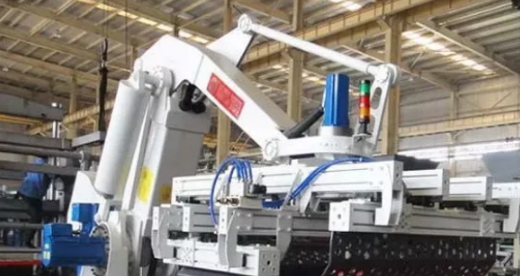
Palletizing robots, a product of the organic combination of mechanics and computer programs, offer higher productivity in modern production and have a wide range of applications in the palletizing industry. Palletizing robots significantly save labor and space. The use of slewing bearings in palletizing robots enables flexible, fast, and highly stable operation, resulting in high work efficiency. In recent years, lightweight, high-precision small slewing bearings have been widely used in similar products, such as robotic arms, spot welding robots, canning machines, and automated production lines. These products require flexible operation, precise positioning, and lightweight, fast operation, so lightweight, precision slewing bearings are generally used.
The above is a detailed introduction to the application of slewing bearings in the field of robotics.
About LJHB:
LuoYang JinShuo Precision Bearing Co., Ltd. is mainly committed to the R&D and sales of high-precision bearings and other special products, and provides bearings and transmission parts with high performance for customers' equipment. With quick response, from pre-sales technical communication to on-time production delivery, as well as perfect after-sales service, we win the recognition and trust of customers.
Our main products include cylindrical roller bearings, tapered roller bearings, slew bearings, gear drives, spindle bearings, crossed roller bearings, turret bearings, thin-wall bearings, tandem roller bearings, spherical roller bearings, etc. The bearing dimensions rang from 100mm to 6000mm, the accuracy reaches P5, P4 and P2 levels. The bearing are widely used in mining and metallurgy, industrial equipment, industrial gearboxes, petroleum equipment, cranes, medical equipment, robotic equipment, etc. Among them, cylindrical roller bearings with better performance and high-precision deep groove ball bearings have been explored for high-speed tubular strander rotating cable equipment, which have completely replaced imports, saving customers costs and time, and improving work efficiency. It has been recognized and widely praised by customers.
Contact LJHB:
Address: Yiyang Bearing Industry Zone, Luoyang City, China 47100
Tel/Wechat: +86-18037970383
Whatsapp: +86-18037970383
Fax: 0086-379-65199160
E-mail: lyjh@lyjhbearing.com
Website: www.chinajhbearing.com