Bearing failures are best classified according to their root causes, but it is not always easy to directly correlate the causes with the characteristics (symptoms) or the failure mechanisms with the failure modes, as numerous related studies have confirmed.
Cracking occurs when localized stress exceeds the tensile strength limit of the material, causing cracks to initiate and propagate.
Fracture is the result of a crack completely propagating across a cross-section of the part, or extending to such an extent that a portion of the part completely separates from the original part.
(1) Overload Fracture
This is caused by stress concentrations exceeding the tensile strength of the material, and can also be caused by excessive local stress (such as impact) (see Figure 2) or by excessively tight interference fits, such as excessively high hoop stress (see Figure 3).
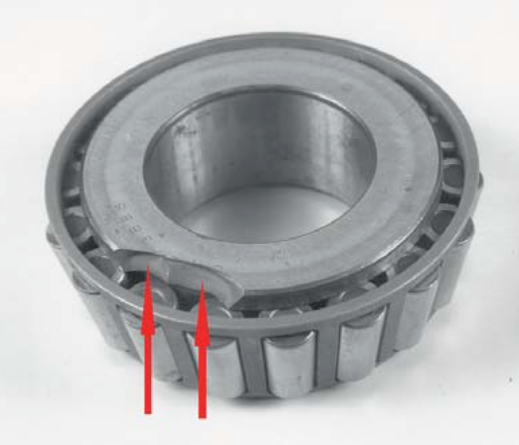
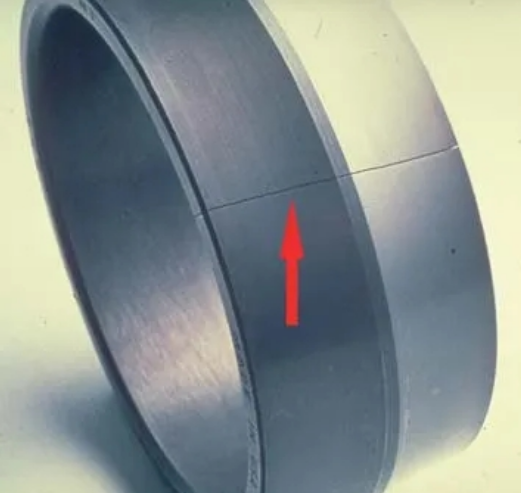
Note: This fracture is caused by an excessively tight interference fit during installation (for example, pushing the inner ring of the tapered bore too far onto the tapered shaft).
(2) Fatigue Fracture
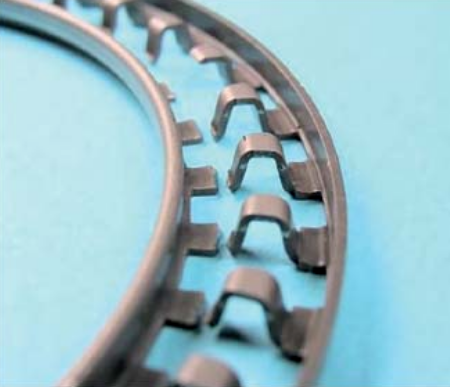
Under bending, tensile, and torsional conditions, repeated stresses exceeding the fatigue strength limit can cause fatigue cracking. Cracks originate at stress concentration points and gradually propagate to a portion of the component's cross-section, ultimately leading to overload fracture. Fatigue fractures primarily occur in the raceways (see Figure 4) and cages (see Figure 5).
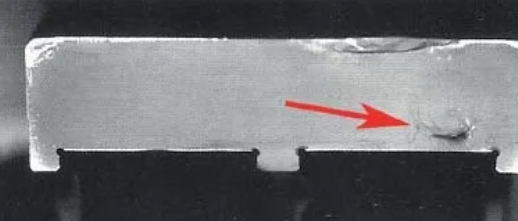
Note: The fracture originated near the right raceway, with its center located within the seashell-like pattern left by fatigue crack propagation (the damage on the outer surface is secondary damage and occurred when the ring fractured).
(3) Thermal Cracking
Caused by high frictional heat generated by sliding, cracks usually appear perpendicular to the direction of sliding (see Figure 6). Hardened steel parts are generally more susceptible to thermal cracking due to the combined effects of localized surface re-hardening and the formation of high residual tensile stresses.
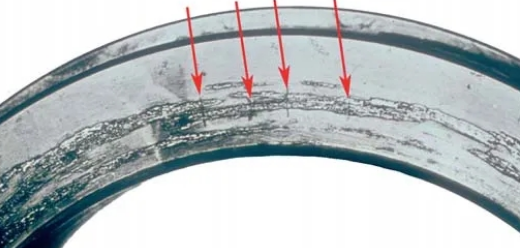
Causes of failure and preventive measures
Fracture
(1) Overload fracture
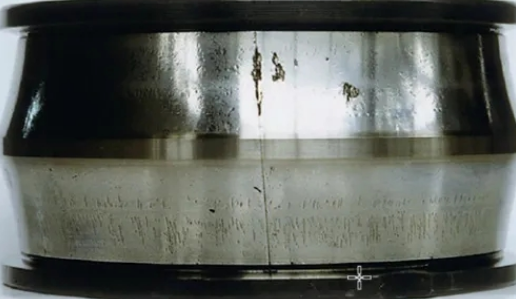
Overload fracture of the inner ring of a self-aligning roller bearing.
Cause of failure:
—Large fitting stress caused by the temperature difference between the shaft and the inner ring.
Preventive measures:
—Adjust the interference fit;
—Check the operating conditions.
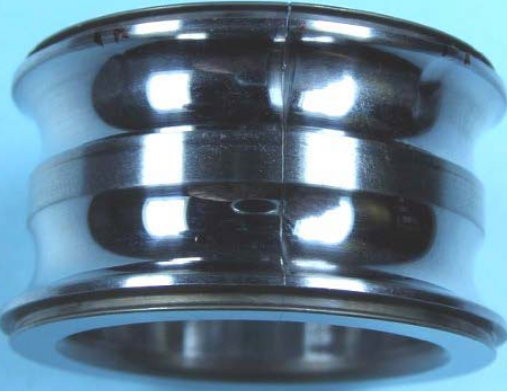
Overload fracture of the inner ring of a deep groove ball bearing.
Failure Cause
—Static overload during stationary periods.
Preventive Measures
—Avoid overloading;
—Use bearings with higher static load capacity.
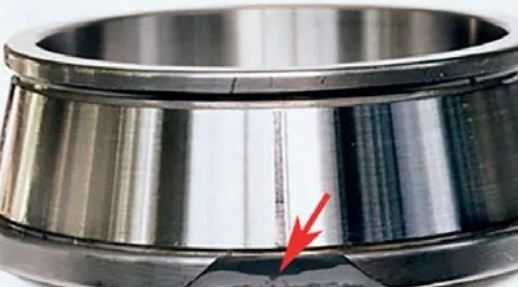
Overload fracture of the large rib on the inner ring of a tapered roller bearing.
Overload Fracture of the Inner Ring Large Flange of a Tapered Roller Bearing
Cause of Failure:
— Severe impact during installation.
Preventive Measures:
— Use appropriate installation tools and procedures.
fatigue fracture
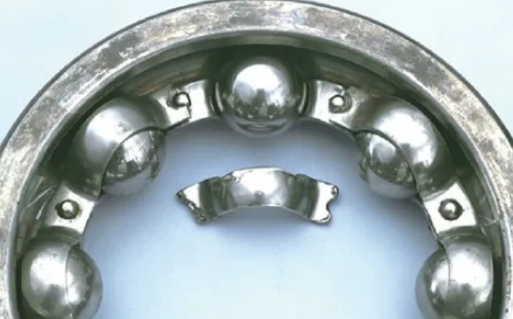
Fatigue fracture of deep groove ball bearing cages
Causes of failure:
— Misalignment;
— Abnormal loads are applied to the cage during bearing operation due to misalignment between the inner and outer rings during installation.
Preventive measures:
— Improve alignment;
— Improve installation methods;
— Select appropriate cage type and material.
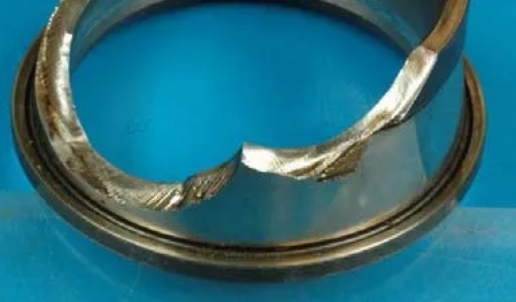
Fatigue fracture of the inner ring of a tapered roller bearing
Cause of failure:
—Due to impact during installation, cracks initiated at surface defects; these cracks then propagated due to fatigue under bending stress associated with variations in axial load during use.
Preventive measures:
—Install carefully.
thermal cracking
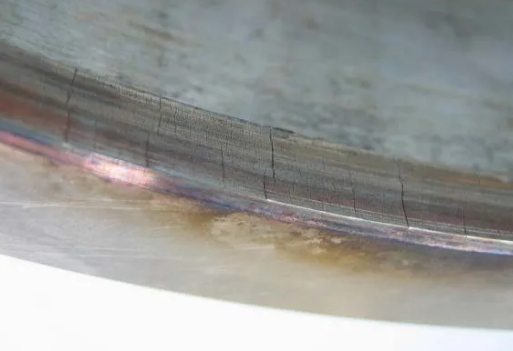
Thermal cracks on the outer side of the outer ring flange of a cylindrical roller bearing.
Failure Causes:
— Lubrication problems;
— The cage pockets are worn through, and the outer ring-guided cage experiences severe friction with the outer ring flange, generating excessive heat and causing thermal cracking.
Preventive Measures:
— Ensure the use of appropriate lubrication (type, viscosity, and quantity);
— If possible, use a roller-guided cage.
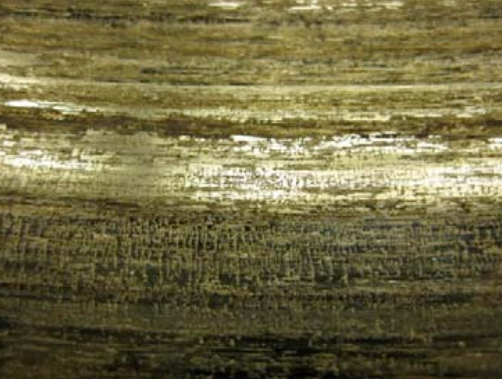
Thermal cracks on the inner diameter surface of the inner ring of a tapered roller bearing.
Causes of Failure:
—Loose fit between the inner ring and the shaft, generating excessive heat due to friction;
—Poor lubrication between the inner diameter surface of the loosely fitted inner ring and the bearing mounting area on the shaft.
Preventive Measures:
—Follow the shaft fit recommendations provided by the bearing manufacturer;
—Ensure proper lubrication for bearings that are loosely fitted onto the shaft.

Thermal cracks on the large end face of the rollers in tapered roller bearings.
Cause of failure:
—Under poor lubrication conditions, friction and heat are generated between the large end face of the roller and the inner ring flange.
Preventive measures:
—Improve lubrication;
—Shorten the lubrication cycle.
Summary
Based on the indications included in this standard, a visual inspection of the bearing parts and adjacent components should be performed. If this initial investigation does not yield relevant conclusions regarding the cause of bearing damage or failure and possible preventive measures, it is recommended to consult the bearing manufacturer or an independent laboratory capable of performing bearing failure analysis to discuss the necessity and relevance of further analysis.
For example, further investigation of different bearing parts can be conducted using some of the methods listed below:
— Geometric measurements of parts related to the damage or failure to check for possible changes in dimensions, geometry, or surface accuracy; metallurgical investigation of metal parts using appropriate tools (optical microscopy or non-destructive techniques) or destructive methods (such as metallographic analysis) for high-magnification inspection;
— Physicochemical investigation of organic parts and/or contaminants;
— In some cases, the failure mode may have altered certain aspects and/or properties of some parts to such an extent that their original state cannot be determined. In such cases, further analysis may not provide new value to the investigation.
About LJHB:
LuoYang JinShuo Precision Bearing Co., Ltd. is mainly committed to the R&D and sales of high-precision bearings and other special products, and provides bearings and transmission parts with high performance for customers' equipment. With quick response, from pre-sales technical communication to on-time production delivery, as well as perfect after-sales service, we win the recognition and trust of customers.
Our main products include cylindrical roller bearings, tapered roller bearings, slew bearings, gear drives, spindle bearings, crossed roller bearings, turret bearings, thin-wall bearings, tandem roller bearings, spherical roller bearings, etc. The bearing dimensions rang from 100mm to 6000mm, the accuracy reaches P5, P4 and P2 levels. The bearing are widely used in mining and metallurgy, industrial equipment, industrial gearboxes, petroleum equipment, cranes, medical equipment, robotic equipment, etc. Among them, cylindrical roller bearings with better performance and high-precision deep groove ball bearings have been explored for high-speed tubular strander rotating cable equipment, which have completely replaced imports, saving customers costs and time, and improving work efficiency. It has been recognized and widely praised by customers.
Contact LJHB:
Address: Yiyang Bearing Industry Zone, Luoyang City, China 47100
Tel/Wechat: +86-18037970383
Whatsapp: +86-18037970383
Fax: 0086-379-65199160
E-mail: lyjh@lyjhbearing.com
Website: www.chinajhbearing.com