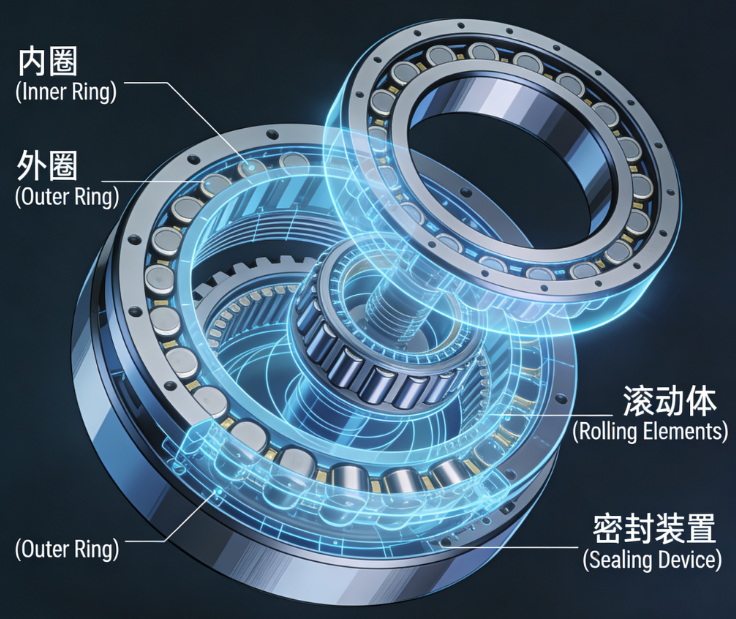
In the industrial field, there is an "invisible hero" that supports the rotation and load-bearing of various equipment: slewing bearings. From small precision medical devices to large heavy construction machinery, all rely on the assistance of this "machine joint".
Core Structure: Four Key Components
The slewing bearing structure appears complex, but its core consists of four parts:
■ Inner and Outer Rings: The main load-bearing components, mostly made of high-strength steel, some with gears for power transmission, and surface hardened to improve wear resistance;
■ Rolling Elements: The core transmission components, divided into ball bearings and roller bearings, determining load-bearing characteristics;
■ Isolating Blocks/Cages: Fix the position of the rolling elements, ensuring smooth movement;
■ Sealing Devices: Prevent dust and moisture intrusion, avoid lubricant leakage, and adapt to harsh environments.
Main Types and Common Applications
Based on the arrangement of rolling elements, slewing bearings are mainly divided into five categories, suitable for different working conditions:
1. Single-row four-point contact ball bearing: Compact structure, suitable for light to medium load equipment such as small and medium-sized excavators and tower cranes;
2. Double-row unequal-diameter ball bearing: High load-bearing capacity, suitable for medium to heavy load equipment such as tower cranes and mining excavators;
3. Single-row crossed roller bearing: High precision and rigidity, used in precision equipment such as CNC machine tools, industrial robots, and CT scanners;
4. Three-row roller bearing: Strongest load-bearing capacity, suitable for ultra-heavy load equipment such as bucket wheel excavators and offshore drilling platforms;
5. Light-duty series: Lightweight and flexible rotation, suitable for light industrial scenarios such as food machinery and environmental protection equipment.
In addition, wind turbine generator sets (yaw and pitch bearings) in the new energy field, port cranes, and military equipment are also important application scenarios for slewing bearings.
Key Selection and Industry Trends
Three key points to consider when selecting a slewing bearing: first, clearly define the load capacity; second, match the installation space with the equipment structure; and third, adapt to the operating environment (e.g., corrosion-resistant design for marine environments).
The current mainstream industry trend is "intelligentization, customization, and high efficiency"—integrating sensors to monitor operating status, designing dedicated models for special working conditions, and optimizing the structure to extend service life. With the expansion of the new energy industry and the upgrading of industrial equipment, the global slewing bearing market is steadily growing.
Conclusion
As the "rotating joint" of industrial equipment, the slewing bearing, though inconspicuous, directly determines the reliability and operating efficiency of the equipment. Understanding its basic characteristics and application logic allows for a clearer understanding of the core operation of industrial equipment.